Categories
Hummingbird Food

Proper Storage of Hummingbird Nectar Solution

Whether you are an avid hummingbird enthusiast or if you are a new fan of hummingbird watching, it is important to be aware that your hummingbird feeders will need to be refilled quite frequently. With this in mind, you may wish to make a fairly large batch of homemade nectar solution ahead of time. Regardless of if you choose to make your own nectar solution or to buy it, you must know just how long it can be kept in the refrigerator and how to store it properly and safely.

Until you have some idea of the number of hummingbirds that will be frequenting your feeders, I would recommend making just enough nectar solution to refill your feeders at the given moment. This helps ensure that the solution is fresh at the time your feeders are replenished.

Once you have a better idea of the number of hummingbirds that will likely be visiting your feeders and with what amount of regularity this will likely occur, you may then decide to mix up a larger batch of nectar solution. This homemade nectar solution can be stored in your refrigerator for up to two weeks. It is important that the nectar solution be properly labeled to ensure that the contents of the container are clearly known to all.

In what type of container should any unused homemade nectar solution be stored? It has been my own experience that either empty milk containers or empty two liter soda bottles seem to work quite well. Another suggestion would be a glass canning jar with a tight fitting lid.

If you should choose to use packaged nectar solution rather then making your own, please be sure and follow the label’s own instructions concerning how to safely store it properly.

A final word of caution, regardless of if you make your own homemade nectar solution or you choose to use packaged nectar solution, if you have any doubt as to whether or not the solution is still safe or not please discard it as a precaution. If the mixture is discolored, foul-smelling or cloudy this would indicate that the mixture has spoiled and must be disposed of immediately.
Categories
Hummingbirds

Is It a Male or Female Hummingbird?

Do you know how to tell the difference between a male and female hummingbird? This is often quite difficult to determine with certainty, but there are distinguishing characteristics which can help with this process. This includes size, migration habits, plumage and tail. This post will discuss the characteristics which will aide you in becoming more of an expert at determining if the hummingbird at your feeder is a male or a female.

Generally speaking, female hummingbirds are usually larger than male hummingbirds. This is not always the case though so this is not an absolutely foolproof way to help you determine the gender of the bird. Also, it is necessary for the female hummingbird to be slightly bigger to be able to produce eggs, to afford to share their body heat with the eggs while incubating, and to be able to share their food when feeding nestlings.

It is the male hummingbirds which migrate first before the females and the juveniles. The males will migrate up to three weeks ahead of the females and the juveniles, so if you think a hummingbird which is migrating early then this could indicate that the bird is a male hummingbird.

There is a difference in the plumage of the male and female hummingbird. It may come as a bit of a surprise to many of you, but it is only the male hummingbird which has the brilliant iridescent throat feathers. Just in case you were wondering, yes, these feathers serve two very important functions: attracting a female and defending their territory. They use these to display to one another. Females find it attractive, and other males are repelled. Male hummingbirds are extremely feisty and territorial and these feathers are part of their territorial display.

The tail of a hummingbird can provide a vital clue to help determine if it is a male or female hummingbird. Most of the time, the tail of an adult male hummingbird will be solid in color while most female and juveniles’ tails have white tipped rather then solid in color.

There is no absolutely foolproof method of determining the gender of a hummingbird, but with the aide of the characteristics listed above you should have much greater success in doing so. Best of luck everyone and happy birdwatching!

Categories
Hummingbirds

Hook-billed Hermit Hummingbird Facts

According to the website eHow.com, the Hook-billed Hermit Hummingbird is the only hummingbird species to be listed under the Endangered Species Act or ESA. This species of hummingbird lives in the forest of eastern Brazil. The habitat of the Hook-billed Hermit Hummingbird is being damaged and destroyed due fire and road building.

Also, global warming or a rise in the temperature of the Earth’s atmosphere is effecting the migration of hummingbirds in general. This may cause the hummingbirds to be in unusual locations and thus find that the food supply is quite scarce.

Categories
Dear Mom Hummingbirds

Are Hummingbirds Born With Feathers?

Are hummingbirds are born with feathers? I must admit that I never even considered this question until someone asked me this recently. I assumed, I knew the answer, but decided to do some research on the matter before answering the question. I am so glad that I took the time to research this topic or my answer would have been wrong. The surprising results of my findings are discussed in this post.

When baby hummingbirds are born they have no feathers and their skin is darker then that of an adult hummingbird. By the time the young bird is only nine days old it will be covered in tiny feathers and it will also be able to maintain its own body temperature, which the young hummingbird could not do prior to this. At only two weeks of age a young hummingbird will begin looking like an adult hummingbird.

As a person who has studied and discovered a vast amount of information on the subject of hummingbirds, I find it somewhat embarrassing to admit that I did not know the answer to this question without doing some research on the subject. This just goes to show that it is impossible for anyone to know absolutely everything about any given topic no matter their knowledge level on a particular topic. It is also one of the many reasons that I am continually fascinated by the subject of hummingbirds and why I always look forward to sharing all that I discover along the way with all the readers of this blog.

Lastly, I would have loved being able to share this information with my mom. This is the type of little known facts that would have certainly captured her attention. While you are often on my mind mom, thoughts of you seem to especially come to mind as I write the content for this blog, because our shared love and enjoyment of hummingbirds will always serve as yet another way of commenting us to one another.

Categories
Hummingbird Pictures Hummingbirds

Costa’s Hummingbird Facts and Photo

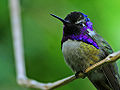
Male Costa's Hummingbird showing his colors

The Costa’s Hummingbird is named for the French nobleman Louis Marie Pantaleon Costa, and this particular species of hummingbird is native to parts of the desert southwest in the United States and sections of northern Mexico.

The Costa’s Hummingbird’s normal heart rate is between 500 and 900 beats per minute. At night, when the bird goes into a state of torpor, which is similar to hibernation, the heart rate can go as low as 50 beats per minute.

It is quite often difficult for researchers to study this particular species of hummingbird. The reason for this is due to the close resemblance of the young and the female Costa’s hummingbird to two other types within their range—the Anna’s and the Black-chinned hummingbird.

The photo for this post was taken from Wikipedia, the free encyclopedia. The factual information was gathered from other sources and put into my own words.