Categories
Dear Mom

What Does Hummingbird Banding Teach Us?

This post makes me think of my mom, because she was always curious as to how exactly researchers were able to study and learn about hummingbirds.  When this subject came up in discussion, my mom had said to me that she had heard of the term banding before but that she wasn’t really sure how that would tell researchers any kind of useful information.  At the time, I did not have an explanation that would answer her question.  Well, I have since discovered the answer and will now share it with all of you.

The term banding simply refers to the placement of tiny, lightweight aluminum band on the hummingbird’s feet which has a unique identification number on them that will belong to a specific bird throughout its entire lifetime.  This band will serve to help researchers begin to better understand things like hummingbird migration, behavior, ecology, and biology.  The collective information gathered by the various banders or members of the pubic will  provide information on things such as longevity survivorship, site fidelity, migration routes, and the timing of these birds.

While the bird is being banded, it remains in captivity only for a very brief period of time, a matter of just a few minutes, so absolutely no harm will come to the bird as a result of it.  During this time, researchers are gathering data on such things as the bids species, age, sex,the lengths of the bird’s bill, wing and tail, the condition of the feathers, evidence as to whether or not breeding has taken place, if disease or parasites are found on the bird, and finally pollen samples or some of the feathers may be gathered and studied.

So you see, even the brief encounters that the bird banders get to have with the hummingbirds it provides them with valuable information on these birds.  Are you at all surprised by just how much hummingbird banding can teach us about these birds?  I truly believe that my mom would have been completely shocked to discover the sheer volume of information that hummingbird banding can tell us about these utterly fascinating birds.  With luck, this knowledge will help to ensure the long-term survival of these creatures called hummingbirds.

Much of the information for this post comes from Patterson Field Guides:  Hummingbirds of North America by Sheri L. Williamson.  As the author of this book, I wish to ensure that she is given proper credit for her work.  Thanks for providing such an informative resource for anyone wanting to learn about hummingbirds. 

Categories
Dear Mom Hummingbird Food

Use White or Beet Sugar In Feeders

I recently made a very surprising discovery concerning homemade hummingbird nectar, which is that beet sugar can be used to make homemade nectar.  Did you know this?  I’m not sure if my mom was aware of this or not, but I’m sure if not she would have found the discovery fascinating.   She so enjoyed attracting hummingbirds to the yard and as a result always had many feeders and therefore was often refilling them.  I believe that my mom would have alternated between the two types of sugar just to try and find out if one was more popular then the other.

I myself have always thought it only safe to use white table sugar in making homemade hummingbird nectar, but it turns out that you can also use something known as beet sugar.  I’m not sure if this can actually be purchased or if they are talking about the natural sugar produced by the beet plant.

It turns out that testing has been done and that white sugar and beet sugar have been found to be equally good for use in hummingbird feeders.  There is no significant difference nutritionally between the two types of sugar.  There is only a minimal difference in mineral content and that is of no importance.


Categories
Dear Mom

Hummingbirds of Southeast Texas

My mom and I loved to watch the hummingbirds that visited our yard while sitting on the back porch. At the time, neither of us had any knowledge whatsoever about these amazing birds, but we just enjoyed watching their antics and behavior. Well, guess what? I have since discovered many things about the hummingbirds found in southeast Texas. What is the he most common species of hummingbird found in southeast Texas? When do the hummingbirds found here migrate through the area? What species of hummingbirds you will see during the winter season? So, if this is the type of information that you would like to know yourself, please keep reading this post.
 
In southeast Texas, the most common hummingbird to be found here is the Ruby-throated Hummingbird. The spring migration season last from March through May and you will see these birds pass through the area on their northbound journey. You will then begin to see the southbound migrants begin to appear in mid-July and there will be an increase in the numbers in September, with the occasional straggler appearing through November.
 
In the winter months, we have several species of hummingbird that can be found in Texas. The most common species are the Rufous Hummingbird and the Black-chinned Hummingbird, but although a rarer occurrence you could also see the Allen’s, Anna’s, Calliope, Costa’s, Broad-tailed and Buff-bellied Hummingbirds too.
Categories
Dear Mom Hummingbird Food

Azaleas and Hummingbirds

Whenever I see azaleas it makes me think of my mother, because for many years there were pink and white ones that lined the flower bed that was on the side of our driveway. I even remember one year on Easter she took a photo of some of my nieces and nephews sitting on the grass in front of those bushes holding their Easter baskets.

As I have stated many times before, my mom loved to try and attract the hummingbirds to our yard with the plants and flowers which were found in our yard. I do not know if my mom specifically planted azaleas because she knew that they would attract hummingbirds and butterflies or not. Did you, mom? It may surprise you, as it certainly did me, to discover that azaleas are poisonous to humans. Were you aware of this fact, mom?

If you choose to plant azaleas as a way to attract both hummingbirds in butterflies, there are several things you need to keep in mind. This information should help you have greater success growing azaleas.

Different varieties of azaleas have a different sun requirement, which means that some varieties will grow in full sun while others will require that it be planted in a shady spot. Azaleas should be grown in raised beds. It is important to keep the soil moist but not overly wet. When you plant the azaleas, you should add mulch, peat moss and other organic materials in generous amounts. These plants grow well in acidic conditions. You will want to add root stimulator and keep them well mulched. Azaleas should be fertilized after they have boomed.

I hope this information provides you will the knowledge to have great success with growing Azaleas. Even though these plants are poisonous to humans, it does not lesson my enjoyment of them, because of the fact that they remind me of my mom and they are known to attract the hummingbirds.

Categories
Dear Mom

Understanding Hummingbird Mirgration

Mom, I know you were aware that hummingbirds migrate, but  did you ever wonder what became of them after they left our area?  If so, I now have the answer.  Since I am not able to share the information with you personally, I will share it with those of you out there who read this blog and may not have much knowledge about hummingbird migration.
 
Hummingbirds migrate twice a year, in the spring and in the fall. Prior to making this journey, it is necessary for the hummingbird to gain between 25-40 percent of its body weight. The various hummingbird species will take a different migration path. Hummingbirds will make this journey alone rather then in groups and these birds will follow the exact same route year after year. 
 
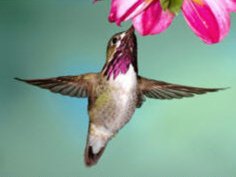
Calliope hummingbirds bare the distinction of being the smallest bird that is known to breed in North America. It will spend the summer in the western mountains as far north as British Columbia. They will begin their journey north starting in March from northern and central Mexico, where they keep their winter homes. They start to migrate back during August.
 
One very interesting fact about the Female broad-tailed hummingbird: it may actually return to the same tree or bush every year to nest. Most of these birds spend the winter in the Mexican mountains. Broad tailed hummingbirds migrate as far north as British Columbia for the summer months, with some stopping in Texas, New Mexico, California and Wyoming along the way.