Categories
Dear Mom

Gone but Never Forgotten

Today marks the second anniversary of your death mom.  In many ways it seems as if your death occurred just the other day and in other ways it seems as if it happend a lifetime ago.  Either way, I still miss you each and every single day.  I just wanted to let you know that you are still loved and will forever live on in my heart and my memories.  You should know that I am and will forever be proud to be your daughter.  I was truly blessed to have had you for my mom.  

As I said mom, I miss you each and every single day, but I know that you are still with me in spirit and that gives me a great deal of comfort.  It comforts me to know that you are now in Heaven and that you are looking down on me, and I only hope mom that you like what you see and that you are proud of the women I have become and the life I am living.  

Thanks mom for all the love, encouragement, self-confidence and determination you helped to enstill in me in my life.  It has helped to shape and mold me into the strong, determined women I am today.  I know I am very blessed to have been your child.  That will always be true and you will never be forgotten! 


Categories
Hummingbird Food

What Does a Hummingbird Eat?

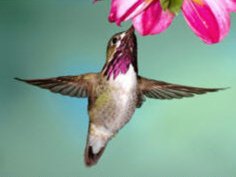
The hummingbirds diet consist of nectar, both from flowers and hummingbird feeders, and insects.  Nectar is the primary food source, but insects are also neccessary as a source of protein. 
 
90 percent of the hummingbird’s diet consists of nectar from flowers or feeders. The hummingbird will eat between 5-8 times per hour for about 30 seconds at a time.  A hummingbird may visit about 1000 flowers per day. 
 
They also eat insects and spiders which provides the protein necessary for their diet.  Protein is of vital importance to a hummingbird, because they can not survive on nectar alone.

How Does a Hummingbird Awaken from Torpor?

Torpor is a state similar to hibernation. Hummingbirds must enter this state to ensure that the birds won’t actually starve to death before down. Torpor is a type of deep sleep where an animal lowers its hart and metabolic rate. In a state of torpor the hummingbird lowers its metabolic rate by as much as 95%. A torpid hummingbird consumes up to 50 times less energy than when awake.

The sleep of torpid hummingbirds is a sleep that is as deep as death. According to the book, American Ornithology, written by Alexander Wilson in 1832, torpor is described as follows: "No motion of the lungs could be perceived … the eyes were shut, and, when touched by the finger, [the bird] gave no signs of life or motion."
 
Hummingbirds reliably awaken from torpor one or two hours before dawn without any known cues from the environment. It appears that the bird’s internal circadian clock is responsible for signaling when it is time to awaken from the state of torpor. 


Categories
Hummingbird Food

What is Hawking?

When the hummingbird catches the insect, this is done using a process known as “hawking.” This is when the hummingbird flies and dives to capture the insect out of the air.
Categories
Hummingbird Food

Plants Known to Attract Hummingbirds


Bee Balm

This perennial blooms in midsummer and grows about three feet tall. There are many varieties of colors and sizes available at nurseries. The variety Jakob Kline is resistant to powdery mildew.

Cardinal Flower

The red spike of flowers arises from the basal leaves of this perennial in late summer. This plant tolerates some shade and prefers a moist soil.


Trumpet Creeper

A tall, vigorous vine, the large flowers are very attractive to hummingbirds. The pictured variety has yellow flowers but most often they have red flowers.

Coral Honeysuckle

This plant is considered a well-behaved vine which flowers profusely in April and May and then sporadically throughout the summer. With the return of cooler weather in the fall, it flowers heavily again. The pictured variety has yellow flowers but they are usually pinkish-red.


Columbine

This perennial blooms from April to June and grows about one foot high. It tolerates some shade and likes to grow amid rocks.

 
All information listed above comes from the Migratory Bird Center. You may find out much more about them by clicking on the link provided below.
 
http://nationalzoo.si.edu/conservationandscience/migratorybirds/webcam/hummingbirds.cfm