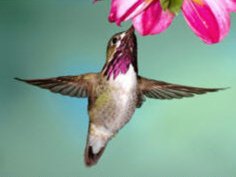
No Bird House for the Hummingbird

While many species of birds use bird houses for their home, the hummingbird does not do so. Therefore, you cannot purchase or build a bird house for a hummingbird. It is my hope that this post will help explain why hummingbirds do not use bird houses. 
 
Hummingbirds are not cavity nesting birds. A hummingbird will make their small, cuplike nests in the fork of a tree branch. The nest is made of downey-like materials for their nesting like plant down, lichens, spider webs, etc.
 
A hummingbird nest is very tiny. It is difficult to describe just how tiny the nest is but I will try to give you some idea of its extremely small size. One source described the size of the nest as being about the size of a quarter. Another one described it as being about the size of half an English walnut shell. Either way, that is indeed very tiny.

The Ability to Hover

The ability to hover is very important to a hummingbird. The hummingbird has the ability to due so better then other species of bird. Have you ever wondered why the hummingbird’s ability to hover is so good? If so, this post will provide you with the answer.
 
Hummingbirds have the ability to hover better than any other species of bird due to the unusual structure of their wings. They have the ability to do so because their wings are permanently fixed and rigid, except at the shoulder joint, which allows the wing to move freely in all directions.
 
When hovering, a hummingbird’s wing moves forward, and then the leading edge rotates nearly 180 degrees and moves back again. This wing movement causes the tips of the wings to trace a horizontal figure eight in the air.
 
One study of the Rufous Hummingbird found that 75 percent of the bird’s weight is supported by the down stroke, while the other 25 percent is lifted by the up stroke.   It may interest you to discover that most nectar-feeding insects get equal (50-50) support from the up and down motion of their wings.  The same cannot be said of other birds which rely entirely (100 percent) on the down stroke. 
 
The ability of the hummingbird to hover is just one of the many things that make it so unique. This bird never ceases to amaze and fascinate me. I’m constantly wondering what my next fascinating discovery about these birds will be. There is no telling what that will be but you can rest assured that eventually I will share it with my readers.
 

The Smallest Hummingbird: The Bee Hummingbird

The smallest hummingbird in the world is the Bee Hummingbird. This amazingly tiny bird is found in Cuba and is only 2 inches long and weighs less than 0.04 ounces. Isn’t that amazing? I often wonder how something so very small manages to survive. How about you? 
 
This tiny hummingbird beats its wings 80 times per second. It also has the ability to pivot its wings which enables it to stop, hover in midair, and fly backward.
 
Like all hummingbirds, this bird’s diet consists of nectar and insects. The insects serve as a vital source of protein. It is important to remember that no hummingbird can survive on a diet of nectar alone. The Bee Hummingbird eats half their total body mass and drink 8 times their total body mass in water each day. Like other hummingbird species, the Bee Hummingbird requires an enormous amount of calories each and every day due to its extremely fast metabolism. It may shock you to learn that a hummingbird can actually starve to death in as little as two hours. Well, are you surprised?
Categories
Hummingbird Videos

Powdery Mildew

Mark Viette tells about solving the problem of powdery mildew in your butterfly and hummingbird garden.

How to Identify Black-Chinned Hummingbirds

When trying to identify the male Black-chinned Hummingbird there are several distinct identifying features to look for.  The adult male has a more distinct black chin over purple gorget, looks black headed, has a short and slightly forked tail, their bill is long, slightly curved and light in color, and their tail tends to end at or very near their wing tips.  One surprising fact about the male Black-chinned Hummingbird is that their average weight is 3.09 grams, which is less than the female weighs.  

There are also very distinct identifying features for the adult female Black-chinned Hummingbird.  Their bill is long, slightly curved and lighter in color than the male Black-chinned Hummingbird’s bill. The female Black-chinned Hummingbird has a grayer crown and a less contrasting head then its cousin the Ruby-throated Hummingbird.  It is also grayer in overall color then its male counterpart.  The female Black-chinned Hummingbird weighs an average of 3.42 grams, which is slightly more than the male.