Categories
Hummingbird Videos

Birds of Belize-Hummingbirds

This video shows many species of hummingbirds found in Belize, many of which may not be found in the United States.  The video includes the following species: the Stripe-Throated Hermit, White-Bellied Emerald, Rufous-Tailed Hummingbird, Scaly-Breasted Hummingbird.   

The Hummingbird’s Beak

The beak is very important to the hummingbird, because it is what they use to probe into the flowers. On these tiny birds, the beak can seem quite unusual or out of proportion to their body size. Here are some facts about the beak of a hummingbird that you may not have known before. It is my hope that you will find them to be both interesting and informative.
 
  • A hummingbird’s beak is generally shaped the same as any other bird beak, but it is longer in proportion to its body.
  • The edges of the hummingbird’s top beak will overlap the edges of the hummingbird’s bottom beak.
  • The hummingbird’s bottom beak is slightly flexible.
  • Hummingbirds do not use their beaks like a straw. They lap up nectar with their tongues. The hummingbird with take up to 13 licks per second. 
 
Categories
Hummingbird Food

How Quickly Do Hummingbirds Digest Nectar?

The hummingbird can digest nectar very rapidly and efficiently. The nectar will pass entirely through the hummingbird’s digestive system in less than 20 minutes! Due to the large amount of fluid a hummingbird will intake each day, a hummingbird’s daily urine output may exceed 80 percent of its body weight, whenever nectar is found to be plentiful.
 
So, just what determines the amount of nectar a hummingbird must consume each day? The answer may surprise you. The amount of nectar that a hummingbird must intake each day is dependent on a number of factors including activity level, air temperature, quality of available resources, and time of year. The hummingbird will require one and a half times its body weight in nectar to meet its daily energy needs. 
Categories
Hummingbird Pictures

Why Use a Monopod or Tripod?

Photographing hummingbirds can be difficult challenge. After all, these birds move extremely quickly, so any help to improve the odds of getting a good shot are appreciated right? Well, my advice would be to use a monopod or tripod whenever photographing hummingbirds. There are several reasons for this. Let me explain.
 
The tips listed below are not my own. They are found in the book entitled “The Complete Guide Attracting, Identifying and Enjoying Hummingbirds” by Donald and Lillian Stokes. This information and much more on how to successfully photograph hummingbirds was written by Sid Rucker, who is a nature photographer from Dallas, Texas. I wish to ensure that the authors are given proper credit for their knowledge and work.
 
  • It is recommended that you invest in a sturdy monopod or tripod.
  • This will allow you to keep the camera at your eye for hours on end and will be helpful whether using a blind or not.
  • Whenever you are using a tripod-mounted camera, the camera should be placed at such a distance from the feeder that the hummingbird will fill at least two-thirds of the frame.
  • Without the use of these devices, you will miss shots because you are not in a proper position to take the shots whenever the opportunity presents itself.
 So, happy hummingbird photographing everyone! It is my hope that this information will help you improve the quality of your hummingbird shots and make them that much more special to you.
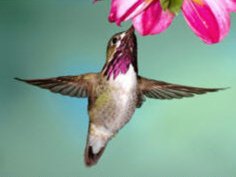


The Buff-bellied Hummingbird

This Buff-bellied Hummingbird is unique among most other species of hummingbirds. Do you know why? The reason for this is because unlike most other species of hummingbirds, Buff-bellied Hummingbirds are alike in color, thus making it much harder to determine the males from the females.
 
The Buff-bellied Hummingbird is found mostly in Mexico, but will also cross the border into Texas.