Categories
Hummingbirds

The Costa’s Hummingbird

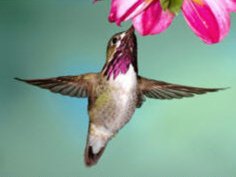
The Costa’s Hummingbird is commonly found in the desserts of California and Arizona.  It leaves the dessert during the hottest days of summer and can then be found to have moved to a shrub, woodland, or chaparral habitat.

One interesting fact about the Costa’s Hummingbird, when it is in a torpid state, its heart rate is only about 50 beats per minute.  When the bird is not in a torpid state and it is resting, the Costa’s hummingbird usually has a heart rate of between 500-900 beats per minute.

This information comes from the Cornell Lab of Ornithology.

Categories
Hummingbirds

What is Gleaning?

Hummingbirds require protein as a part of their diet and about 10 percent of their diet consist of protein.  The hummingbird will gather this through what is known as gleaning, which is when the hummingbirds hunt for insects or other prey while searching on barks, leaves or other surfaces or other hiding places.  So, it seems that the practice of gleaning actually places a vital role in helping to try and ensure that the hummingbird has a more balanced diet.  This is extremely important because no hummingbird can ever survive on nectar alone.

Categories
Hummingbirds

What is a Hybrid Species of Hummingbird?

My boyfriend recently asked me if hummingbirds only breed within their own species.  At the time of his question, I told him that I wasn’t certain of my answer and would have to do some research in order to accurately answer his question.  This is what has prompted me to write this post and the answer may surprise you as it did me.

It is in fact possible for various species of hummingbirds to breed together and create hybrid species.  Some of the species that can come together to do this include the following:  Anna’s, Black-chinned, Allen’s, Costa’s, Rufous, Calliope and Broad-tailed hummingbirds.  This is one fact that complicates the already difficult task of identifying hummingbirds and makes it even more challenging.

Categories
Hummingbirds

Do Hummingbirds Have Toes?

Just for the record, hummingbirds do indeed have feet. Hummingbirds do not walk,  but they hop to move even very short distances.  This will likely surprise you, but hummingbirds actually spend most of their time perching.  The hummingbird will use its feet to help it scratch and to perch.

You many be wondering if hummingbirds actually have toes on their feet.  This isn’t something that most people would know the answer to unless they have had the opportunity to view a hummingbird at very close range.  Yes, indeed they do.  In fact, the hummingbird has a total of four toes on each foot ; three of which are located a the front of the foot and one at the back of the foot called the hallux.  The hallux can be thought of as being similar to a human thumb.  It helps the hummingbird be able to grip onto a tree branch or a wire.

Categories
Hummingbirds

Blue-throated Hummingbird Facts

  • The Blue-throated Hummingbird is about three times heavier than the Ruby-throated Hummingbird.
  • The Blue-throated Hummingbird is different from most other North American hummingbirds because this species of hummingbird does not perform an aerial display. Rather, a male will use several different vocalizations in order to defend its territory and as a way to attract a mate.