Young Hummingbirds and Mirgration

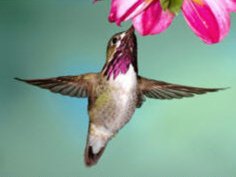
Hummingbirds will tipically follow the same migratoy route year after year.  How does a young hummingbird that has just hatched learn the migratory route to take?  The answer will probably surprise you.

The newly hatched young have no memory of past migrations on which to rely.  They do have the urge to put on a great deal of weight, to fly in a particular direction for a certain amout of time and the urge to look for a place to spend the winter.  Once the hummingbird has learned the route the hummingbird will likely trace that same route each year of its life.

What triggers the urge to migrate in these birds?  The urrge to migrate is triggered by a change in the length of the day or photoperiod. It has nothing to do with what the temperature is or the amount of food that is available.  It may surprise you to discover that hummingbirds will migrate south when the amount of food available is at its greatest abundance.


Categories
Dear Mom

The Hatching of Hummingbird Eggs

Today’s post relates to an earlier post, so I need to offer some background information for those of you who may have missed the earlier entry. The earlier post was about the fact that female hummingbirds lay their eggs on different days rather then a few minutes or hours apart. Well, I just discovered something directly related to the earlier post. As impossible as this seems, even though the eggs are laid on different days they will hatch on the same day. You re not miss reading it, I did state that the eggs will hatch on the same day! How is this possible? Well, let me explain.
 
The female hummingbird can insure that eggs which are laid on different days will hatch on the same day. This occurs because the mother hummingbird is able to delay the full start of the incubation process until the second egg has been laid. Doesn’t that astonish you as it did me? This is is something which my mom would have been fascinated to discover and I hope you too have enjoyed making it also.   

Missing Anatomy Features

The anatomy of the hummingbird is quite unique among some mammals and other birds. What makes it so unique and different is that that they have a number of missing parts. This post will examine what they are and explain why this occurred.
 
Hummingbirds have no bladder or gall bladder! Without a bladder, where is the urine of a hummingbird is stored until it is excreted? It is equally fascinating to discover that a male hummingbird does not have a penis. The female hummingbird has only one ovary, the left ovary.
 
The missing anatomy features are believed to be the result of the hummingbird’s extremely small size. It appears that the deleting of duplicate organs was nature’s way of making enough room for the vital organs.
 
Categories
Hummingbird Videos

Evolution: How Does Evolution Really Work?

This video takes place in Ecuador and examins how the process of natural selection operates in populations of rainforest hummingbirds.

Categories
Hummingbird Feeders

Gain the Attention of Hummingbirds

The use of a hummingbird feeder is a very simple and easy way to attract hummingbirds. Then the question becomes, “where is the best place to hang the feeder?” There is no perfect answer to this question, but the guidelines listed below will help you select where you wish to place your hummingbird feeder or feeders.
 
  • First and foremost, you want the feeders to gain the attention of the hummingbirds! If for any reason the feeder needs to be moved later, you can do so. The birds will look for it even after you move it, because they have learned that your yard is a dependable food source.
  • In warmer weather, place the feeder in a shady area. The cooler the feeder, the less likely it is to leak or drip. Also, your nectar solution won’t spoil as quickly.
  • Placing the feeder in a shady area will prevent the sunlight’s ultraviolet rays from damaging as quickly the materials of which the feeder is made.
  • If you are having trouble with aggressive hummingbirds and you have multiple feeders, then place the feeders at least 30 feed apart from each other. This seems to keep the number of confrontations between the birds to a minimum.
Be sure and place your feeders where you can easily view it. After all, isn’t that the primary reason any bird enthusiast chooses to hang one? Happy bird watching everyone!