Categories
Hummingbird Food

Choosing Plants for Hanging Baskets

Even if you don’t have a lot of space in which to plant flowers, you can easily and effectively attract hummingbirds through the use of hanging baskets. This is a simple and effective way to beautify your yard and attract one of nature’s most amazing creatures. It is my hope that the information which follows will help you to discover how to effectively use hanging baskets as a way to attract and enjoy these truly amazing birds.
 
It is very important that you select the right flowers. You will want to choose flowers that will thrive in hanging baskets and that will also attract the hummingbirds.
 
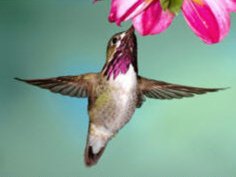
You will want to select plants that have nectar-rich tubular shaped blooms on them. Plants such as penstemon, salvia and petunia are excellent choices, because the hummingbirds can easily access the nectar due to their long, narrow bills and tongues.
 
The plant form is also very important. You will want to select flowers that stick out from a plant’s foliage, by either protruding or dangling. This is important because hummingbirds normally feed while hovering, so this will provide ample air space so the birds’ beating wings easily clear any leaves.
 
The plants you select for use in your hanging baskets should offer a wide variety of color. Many people often associate the color red with helping to attract hummingbirds. Red is a color which hummingbirds can see from a great distance, so offering flowers that are nectar-rich and come in various shades of red should always attract their attention. However, flowers of almost any color, including orange, pink, purple, white and yellow will also attract hummingbirds and cause them to feed from these nectar-rich plants.
 
The quantity of blooms a plant produces will also play an important role in attracting hummingbirds. When selecting plants, you will want to choose plants with multiple flowers in open clusters. These types of plants are more appealing than plants like hibiscus that feature a small selection of large blooms.
 
You will also want to consider the bloom time of the plants you select. Choosing plants that have a long bloom time will help provide the hummingbirds with a source of nectar for an extended length of time. Another way to ensure that the hummingbirds will always have a source of nectar is to select plants that have staggered bloom times.
 
By following these very simple suggestions, you can beatify your yard and effectively attract the hummingbirds. So, don’t let a limited amount of space prevent you from beautifying your yard and attracting the hummingbirds. You will be glad that you discovered how to effectively use hanging baskets and the hummingbirds will also be thrilled with your discovery. 
 
I can tell you from personal experience just how effectively hanging baskets can be used to attract the hummingbirds, because when my mom was still alive we had them all around our yard. The flowers and plants provided our yard with an explosion of bright, vivid colors and the hummingbirds would swarm to them. Another reason my mom loved to use hanging baskets was because she could have such a wide variety of plants all around the yard. 
 
Hanging baskets are an easy and relatively inexpensive way to beautify any yard and they have the added benefit of helping to attract the hummingbird. If you want to attract the hummingbirds in a more natural way, why not give the use of hanging baskets a try?  

The Evolution of the Hummingbird’s Body

Have you ever thought about how all animals bodies have probably adapted through the years to meet their lifestyle and habitat requirements? This had never occurred to me before doing some research on hummingbirds. The hummingbird’s body has gone through such an evolution to meet its lifestyle and habitat requirements. It amazes me that an animal can do so in an effort to survive.
 
How is a hummingbird’s body adapted to its lifestyle and habitat? The pectoral or flight muscles of a hummingbird accounts for ¼ of its total body weight. In humans, the pectoral muscles account for 5 percent of our total body weight. The muscle fibers in hummingbird pectoral muscles enables hummingbirds to keep a rich supply of blood and oxygen flowing into their muscles as they fly, so they don’t tire even with their rapid wing rate. Their beaks are designed to probe into many species of small flowers and to snap up tiny flying insects. The hummingbird laps up nectar by flicking its long, forked tongue deep within a flower at rates up to ten times per second. Its efficiency as a pollinator is comparable to that of a honey bee.
 
I hope that you will find this information to be interesting and even educational. I know that I discovered some things about the hummingbird that I didn’t know before. Is it fascinating how the animals of the world have adapted through the years? Let me know what you think. 
Categories
Hummingbird Videos

The Hummingbird Verses the Spider’s Web

This video shows how some people rescued a hummingbird that had become tangled in a spider’s web.  It isn’t every day that an average individual gets to rescue a hummingbird.  The hummingbird survived the experience and flew away.

Some Cool Facts About the Black-chinned Hummingbird

Even though I have learned a great deal of interesting information about hummingbirds, even the Black-chinned Hummingbird, these are some facts about it that I didn’t know until recently.  My mom truly loved watching the hummingbirds and this is the type of information she would have found quite interesting, so I hope you will too. 

  • In cold weather, a Black-chinned Hummingbird may ingest three times its body weight in nectar in one day.
  • The Black-chinned Hummingbird’s nest can expand as nestlings grow. The spider and insect silk holding it together stretches and allows the nest to grow along with the growing chicks.
  • The male and female Black-chinned Hummingbird may use different habitats during the nesting season, with the male in somewhat drier areas. In a study in Arizona and New Mexico, nesting females spent most of their time in canyon bottoms but often relied on nectar sources on nearby hillsides. Males occupied and defended territories on the hillsides but rarely ventured into the canyon bottoms.
  • The eggs of a Black-chinned Hummingbird average about 13 mm (0.5 in) long and 8 mm (0.3 in) across, about the same size as a whole coffee bean.

I find hummingbirds to be such fascinating creatures and I love making new and interesting discoveries about them and sharing them with you.  I’m continually amazed by the endless variety of information that is available and the never-ending discoveries that I make about hummingbirds.  Happy hummingbird watching everyone!


Blue-Throated Hummingbird

The Blue-Throated hummingbird has been better studied than many of the other southwestern hummingbirds. This hummingbird usually lives along the edges of streams in mountains or canyons. The nest is usually located wherever there is good overhead protection. This species of hummingbird has been known to raise three broods in one season, which is highly unusual among most other hummingbird species.

The Blue-Throated hummingbird is known as a southwestern hummingbird. The   breeding range for this species of hummingbird consists of southeastern Arizona, southwestern New Mexico and western Texas. The breeding period for this particular species of hummingbird is April to July. They migrate northward from March to May and southward from August to October.
 
This hummingbird is the largest of all the North American hummingbirds. This hummingbird weighs 8.4 grams. The Blue-Throated hummingbird is believed to weigh more than the Magnificent Hummingbird is because it has a much longer tail and wings. The male Blue-Throated Hummingbird is unmistakable. Female is similar to female Magnificent Hummingbird but has large white tips to tail and white malar streak. Other hummingbirds are much smaller.
 
The male of this species is larger than the female. This is highly unusual among other species of hummingbirds.  Male hummingbirds are the tiniest warm-blooded animals on the planet. There are several reasons to help explain why females are typically larger than the males. Female hummingbirds are solely responsible for the care and rearing of the young. Therefore, the females need to be a tiny bit bigger to be able to produce eggs, to afford to share their body heat with the eggs while incubating, and to be able to share their food when feeding nestlings. In this species of hummingbird, the fact that the male is larger than the female may suggest that the roles of the sexes are different in this species.