Other Names for Hummingbirds

The Spanish have some very interesting names for hummingbirds and these names are also very descriptive of the hummingbird’s behavior. These names include the following: 
Chupaflor or flower-sucker
Picaflor or flower nibbler

The Portuguese refer to the hummingbird as Beija-flor or Flower-kisser.  

 
It may also interest you to know that not every species of hummingbird has the word hummingbird in its name.  Examples of this include the following: Jacobins, Sabrewings and Woodnymphs. Unless you knew differently, there would be nothing to indicate that these names are in fact different types of hummingbirds.
 
Categories
Hummingbird Videos

Praying Mantis Devours a Hummingbird

The praying mantis is one of a wide variety of predators of the hummingbird.  It may surprise you, as it did me, to learn that praying mantis will successfully capture, kill, and eat a hummingbird. Due to the lightning-fast manner in which the insect strikes it is often assured of success. It may take over a day for the bird to be consumed by the praying mantis, because of the relative size difference. 

 How many of us have ever seen the praying matis kill and eat a hummingbird?  Not many I would imagine.  It is not my intention to offend anyone by posting this video.  It is a known fact that hummingbirds are often killed by the various predators that attack them.  I am just wanting to provide you the opportunity to witteness something you would probably not otherwise see. 

Categories
Dear Mom

The Mighty Heart of the Hummingbird

Of all bird species, hummingbirds have the largest known relative heart size. The heart represents 2.4 percent of their body weightThe heart of a hummingbird is an extremely durable organism that weighs only five or six grams. It is the size of a cranberry and it averages 500 beats a minute, while it is perched. According to an article in the January 2007 issue of National Geographic Magazine, if a hummingbird lived for 17 years its heart would have thumped four and a half billion times, nearly twice the total for a 70-year-old person.
 
I don’t know about you but it is these kinds of little known facts about hummingbirds that never cease to amaze me. It is one of the many things that continually makes learning and writing about these birds so interesting and fun. This is also the type of interesting information about hummingbirds that my mom would have enjoyed discovering, but she isn’t living any longer so I will share my discovery with all of you who visit the blog. 
 
Happy hummingbird watching everyone! I sincerely hope you are enjoying all that you are reading on the blog. If you have any comments or suggestions, please let us know. Also, what would you like to be discussed here in the future?
Categories
Hummingbird Food

Hummingbirds and Nectar

Many people tend to perceive the hummingbird as constantly needing to eat. This is not entirely accurate. Yes, hummingbirds do possess extremely high metabolic rates, but the hummingbird does not eat constantly. On average, a hummingbird will eat between 5-8 times an hour with each feeding lasting about 30 seconds in length.
 
The amount of nectar that a hummingbird must intake each day is dependent on a number of factors including activity level, air temperature, quality of available resources, and time of year. The hummingbird will require one and a half times its body weight in nectar to meet its daily energy needs.
 
The hummingbird can digest nectar very rapidly and efficiently. The nectar will pass entirely through the hummingbird’s digestive system in less than 20 minutes! 
 
Due to the large amount of fluid a hummingbird will intake each day, a hummingbird’s daily urine output may exceed 80 percent of its body weight, whenever nectar is found to be plentiful.
 
Even though they have an extremely high metabolic rate, hummingbirds do not eat until they are full at every opportunity. During daylight hours, the hummingbird will eat frequently for short periods of time. At night, the hummingbird will eat as heavily as the nectar supply will allow. The hummingbird may store a third of its weight in nectar to ensure that it will survive its overnight fast while maintaining its normal resting metabolic rate.
 
I hope you have found this information about the hummingbird’s dependence on nectar informative. Was there anything mentioned in this post that came as a surprise to you? Do you have a comment you would like to make? Please feel free to do so.
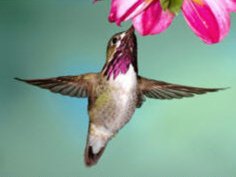


Buzz…Bees and Wasp are Also Predators of Hummingbirds

Have you ever thought of bees and wasp as being predators of hummingbirds before? If you are like me, then this had never occurred to you before. I recently discovered that bees and wasp can indeed be predators of the hummingbird. Let me explain.
 
It seems that other insects, particularly bees and wasps have the ability to sometimes out-maneuver and attack a hummingbird. The result of a single sting may be fatal to a hummingbird, because there is so little body mass to absorb the venom.

Many people who have hummingbird feeders commonly complain about the problem of bees and wasp and they wish to know how to keep them away from their feeders, but I’ll bet very few of us, if any of us, knew that these insects could actually be considered predators of the hummingbird. Now that we do it is very important to solve the problem of these pests at your hummingbird feeders. After all, none of us, I am quite sure, would want to see these insects cause the death of a hummingbird.